

Satluj Was Never About a Loophole. It Was About Who Gets to Write Punjab’s Ending.
A film about a murder for which the police were convicted vanished from an Indian streaming platform within forty-eight hours. The reason given to the public was security. The reason given in briefings to people who asked the right questions was an election. Days later, a column appeared defending the process that produced both. Its author had once been the Deputy Commissioner of Amritsar, in office when Jaswant Singh Khalra was abducted there in 1995. Everything written after that was an attempt to make the first reason sound like the whole story.
The Khalra Abduction Case
In 1995, Jaswant Singh Khalra was abducted after telling the world that Punjab Police had cremated thousands of unidentified bodies during the counter-insurgency years, bodies his own investigation traced to illegal killings the state never accounted for. He was never seen again.
After a CBI investigation ordered by the Supreme Court, six Punjab Police officials were convicted on 18 November 2005 for Khalra’s abduction and murder. Two, including DSP Jaspal Singh, received life imprisonment at trial. The other four were sentenced to seven years. On 16 October 2007, a division bench of the Punjab and Haryana High Court found those four sentences too lenient and enhanced them to life imprisonment. The Supreme Court upheld the convictions and life sentences around 2011. One of the original accused was acquitted.
Lawyers who worked related cases put the wider figure, convictions across the decades for abductions, fabricated records, and illegal cremations tied to that period, at well over a hundred. None of this is disputed history. It is a closed case with verdicts attached.
Satluj: The Film
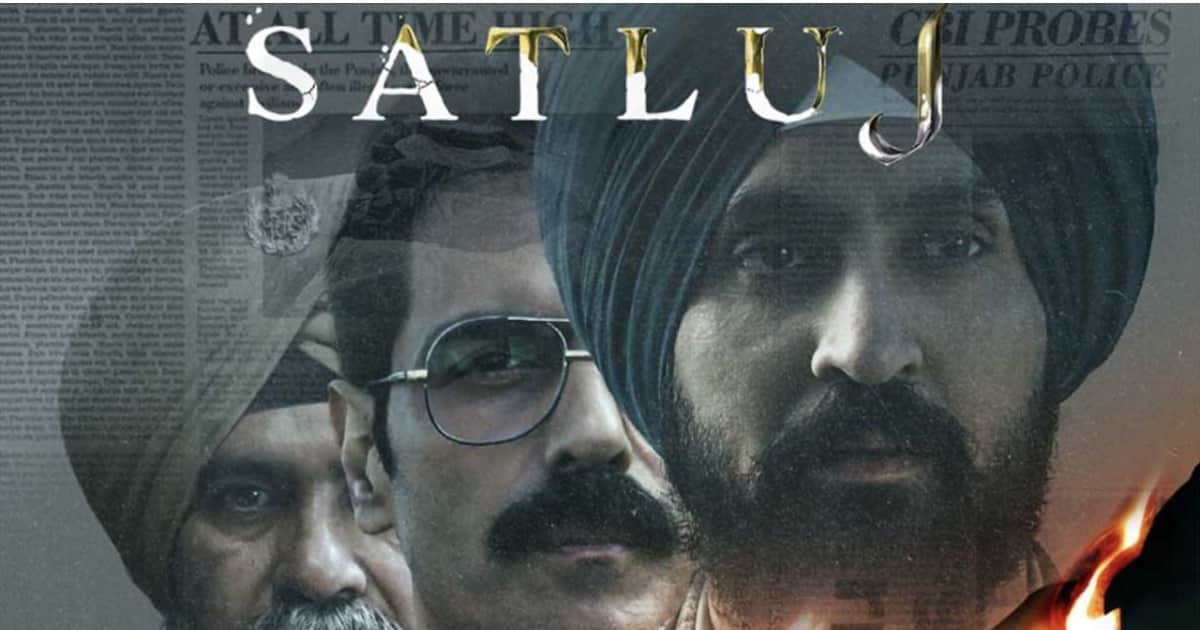
Thirty years later, a film with Diljit Dosanjh in the lead role about that history tried to reach an Indian audience, and the same apparatus Khalra investigated found a new way to keep it from arriving.
The filmmakers first approached the Central Board of Film Certification in December 2022, under the title Ghallughara, later renamed Punjab ’95. By 2023, the board’s objections had produced a list of demanded cuts, and the filmmakers challenged that demand in the Bombay High Court. They then withdrew the petition after CBFC proposed an out-of-court resolution: accept the cuts, drop the case, and receive the certificate.
The director, Honey Trehan, has said he agreed in good faith, calling himself heartbroken but willing to make the changes if it meant the film could finally be released. The board’s demands grew instead, from an initial 21 cuts to eventually 127, and the certificate never came. Rather than accept the final list, the filmmakers released the film uncut on ZEE5 on July 3, 2026, under a new title: Satluj.
The Double Ban
Two days later, the Ministry of Information and Broadcasting ordered ZEE5 to take the film down in India, invoking Section 69A of the IT Act and citing security concerns. The removal came first, as a direct executive order. Only afterwards was a high-level Inter-Departmental Committee constituted under Rule 14 of the IT Rules to review the film and recommend a course of action, its members drawn entirely from the ministries of Information and Broadcasting, Home Affairs, Electronics and IT, Women and Child Development, External Affairs, Defence, and Law. No independent tribunal sat on that committee. No judicial voice was in the room. Its eventual recommendation was that the ban stay, on grounds of sovereignty and integrity, the same objection CBFC had already raised through its demand for cuts, now restated by a different office under a different law.
This is the sequence Karan Bir Singh Sidhu, Deputy Commissioner of Amritsar from 1992 to 1996 and later Special Chief Secretary of Punjab, chose to write into. His column argues that what happened next was a matter of institutional respect, that the filmmakers had exploited a regulatory gap, and that the state’s response was a defence of the rule of law.
Sidhu did not invent this argument, and he did not make it only in print. The same week, Union Minister Ravneet Singh Bittu, whose ministry sits inside the government that ordered Satluj off ZEE5, told the press the debate over the film should not distract from Punjab’s future, using nearly Sidhu’s own phrase, not on reopening old wounds. Officials briefing on the takedown gave a more specific reason than security in the abstract: concern that the film could be used to draw support for a separatist movement ahead of Punjab’s elections. Sidhu himself carried the same argument onto television, sitting for an interview in which he described Satluj as different from other historically charged films specifically because it depicts the Indian state as a perpetrator, and argued the period should be understood through what he called the broader security situation rather than a one-sided narrative, his broadcast version of the same dilution as his column performs in print. The channel let the frame stand unexamined. None of this is a rule-of-law argument. It is an electoral one and a security one, made by the people who actually control whether this film reaches a screen, and carried into households by outlets that gave the argument airtime without asking it to answer for itself.
None of this is really about one retired official’s opinion. It is about the office he once held, the officials who currently hold it, and the platforms that repeated the argument without testing it. Whether or not by design, Sidhu’s column supplied the same vocabulary that a sitting minister used the same week. Whatever his intent, the effect was to translate an incumbent’s electoral calculation into the language of institutional principle, on a channel willing to carry it unchallenged.
Theatrical exhibition and OTT release are not two tiers of the same system. They are separate legal frameworks built for different kinds of transactions. A cinema screening is one fixed cut shown to a public audience simultaneously, which is why the state pre-clears it once for everyone under the Cinematograph Act.
OTT release is on-demand and individually selected, and a 2019 Karnataka High Court ruling had already confirmed that content transmitted over the internet does not meet the legal definition of a cinematograph at all. The filmmakers were not hiding from the law when they moved from one track to the other. They were standing within a distinction the courts had already drawn, having extended good faith to the first institution, which was never repaid.
Nor does the takedown retroactively prove the OTT route was an evasion that finally caught up with them. Section 69A is not a power that exists only to correct people who dodge CBFC. It is a general power, available against any content on any platform, certified or not, whenever the government decides it meets the threshold. Padmaavat carried a full CBFC certificate, cleared through every step of the process Sidhu insists on, and state governments still tried to ban it on public order grounds until the Supreme Court intervened.
A certificate did not protect that film. The lever was pulled regardless of which door it had already walked through. When the same lever was pulled against Satluj within forty-eight hours and arrived at the same conclusion CBFC had already reached, it did not vindicate the certification process Sidhu is defending. It showed that certification was never the only thing standing between this story and suppression, and the electoral rationale officials gave in briefings shows what that something else actually was.
To make his argument work, Sidhu has to do something with Khalra’s murder that the case’s own judicial record does not support. He acknowledges the verdict in a single sentence, then places it inside a count of more than eleven thousand civilian deaths and over seventeen hundred security force deaths across the insurgency broadly, thousands of militants among them, and an economy stalled by years of violence. Every one of those numbers may be accurate. None of them changes what Khalra’s case actually is. His killing was not an unattributed casualty of a chaotic period. It was a state-orchestrated extrajudicial act, investigated, prosecuted, convicted, and enhanced on appeal. Folding a verdict into an aggregate does not provide context for it. It removes the one thing that made this case different from the tragedy Sidhu wants it filed under, which is that people were found responsible and named.
From there, Sidhu moves into Operation Hardball, a present-day American law enforcement action against the Bishnoi criminal network, and into broader concerns about organised crime and narcotics currently active in Punjab. He does not claim the two cases are connected. He uses one to argue the other is badly timed, present danger offered as a reason the past should wait. But nothing in either case explains why accountability for a thirty-year-old, judicially settled killing has any bearing on an active narcotics investigation today. The argument borrows urgency from one crisis to discourage attention to another, without ever showing they belong in the same sentence.
He then asks whether screening the film in gurdwaras serves reconciliation or turns sacred space into a venue for contested political narratives, a question designed to elicit a single answer. It treats the gurdwara as a place of reconciliation that requires protection from this history, rather than a place that has long served as a site of testimony for grief that official channels were often unwilling to hear. What has actually happened on the ground since the takedown answers his question more honestly than his column does.
In Gurdaspur, in Bathinda, in Moga, and in villages across Punjab, residents have organised open-air screenings themselves, arranging projectors, sound systems, and seating, with no political party involved in the planning. In Mehraj, one of Punjab’s largest villages in Bathinda, the idea reportedly began as a conversation between a local resident and a friend living abroad, who then approached a gurdwara management committee directly.
Organisers elsewhere describe crowds of three hundred to five hundred people a night, elderly survivors of the insurgency sitting beside teenagers born after it ended. One man who coordinates screenings in Gurdaspur district said the goal was to give people a place to watch together and reflect on a period of Punjab’s history that still resonates across generations. Attendees have described watching elders in their sixties and seventies weep because the film brought back sons they lost decades ago. That is not a political campaign turning sacred space into a battlefield. It is a community using that space the way it always has.
Sidhu writes that institutions are tested when they are inconvenient, not when they agree with us. That standard applies beyond the man who wrote it. A sitting Union Minister, a Ministry acting through Section 69A, the broadcasters who gave the argument a stage, and a retired civil servant whose column, whatever its intent, supplied the same vocabulary, were all tested by the same film in the same week, and answered with the same instrument: distraction dressed as principle, an electoral calculation dressed as institutional respect, carried without challenge onto the airwaves. CBFC was tested by the film and answered with 127 cuts after accepting good faith it did not repay. The Ministry was tested and answered with a takedown inside forty-eight hours, a committee assembled only afterwards to justify it, with no independent member in the room. The system was tested by its own history and answered with a script, reopening old wounds, repeated in print, in briefings, and on camera, within days of each other. Three tests, three failures, one pattern.
The rule of law was never in danger. What was actually at risk, and what this script was built to make sure nobody had to name, was whether the state could keep a series of convicted killings walled inside a statistic forever. In villages across Punjab, people holding no office and representing no party have been doing what none of these institutions, and none of these platforms, would, setting up a screen, inviting their neighbours, and letting a mother in her seventies watch her son’s story reach an audience at last. Punjab already answered the state’s question once, in a courtroom, with a verdict. Satluj was only ever asking to be allowed to say so.
Read this article in Punjabi @ Zordar Times Punjabi
Leave a Reply